Comparison
Quartzite vs Marble Countertops: Which One Looks Like the Other, and Which One Stains
Updated September 19, 2026 · Enchanted Kitchens, Stamford, CT
Quick answer
Quartzite looks like marble and behaves much better under an acid spill. Marble looks like marble and earns its look with upkeep. If the look is the point and the upkeep is the worry, quartzite is your stone. Whichever you choose, choose it at the slab, with the seams drawn on it, before anyone cuts.
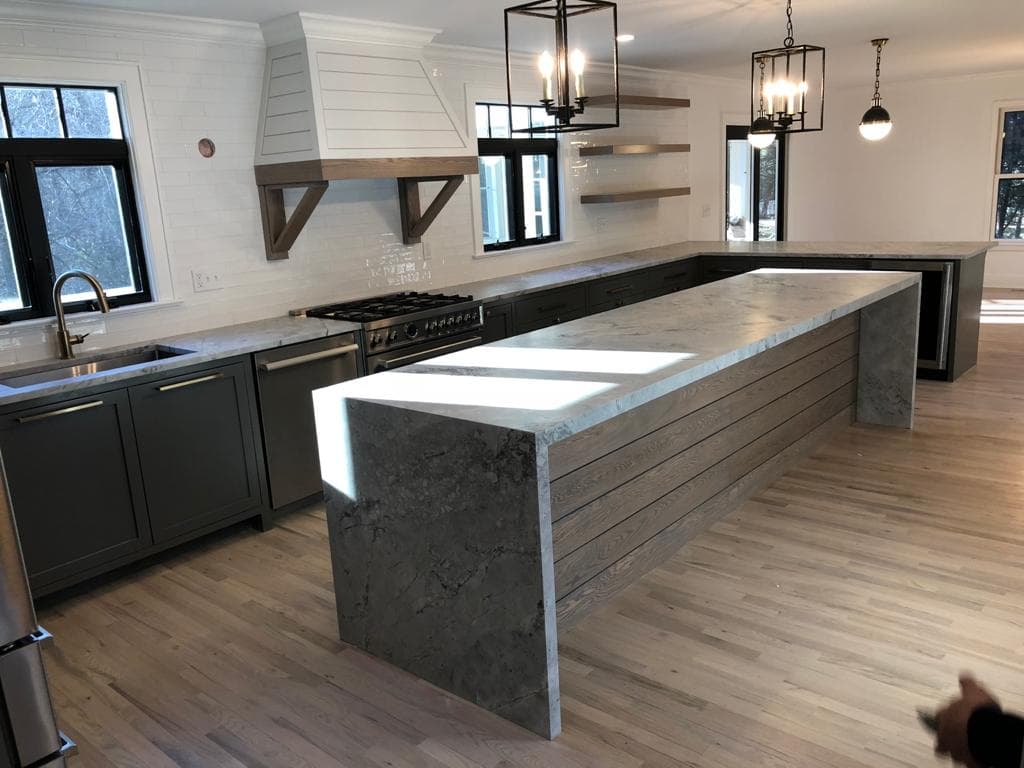
Quartzite and marble get confused for one reason: they can look nearly identical. A white quartzite with soft grey veining reads like marble in a showroom, and it still reads like marble in a bright kitchen a year later.
The look is where the similarity ends. The two stones form differently, wear differently, and ask different things of you. Here is the comparison that matters before you commit to a slab.
What quartzite actually is
Quartzite is a natural stone. It starts as sandstone and is changed over a very long time by heat and pressure into something harder and denser. It is quarried in blocks, cut into slabs, and polished. Most quartzite is white, grey, or beige, with veining that moves in soft waves, fine streaks, or a wide sweep across the slab.
It is still stone, so every slab is different. That matters later in this article.
What marble actually is
Marble starts as limestone and is changed by the same forces into a stone that is softer and more porous than quartzite. It is valued for depth. The veining is bolder, more dramatic, closer to weather than to lines. Carrara, Calacatta, and Statuario are the names you will hear most.
Both stones are natural. Neither is engineered, and neither is a printed pattern.
Which one looks like the other
Quartzite looks like marble far more often than marble looks like quartzite. Quartzite with a white field and grey or gold veining is routinely sold as a marble look, and several well-known quartzites have built their reputation on exactly that. Marble, by contrast, looks like marble. There is no version of marble that reads as quartzite.
So if you are drawn to the marble look but worried about living with marble, you are not shopping for marble. You are shopping for quartzite, and the question becomes whether the look you loved survives the swap in a real slab. It usually does. The difference shows up in how the veins move: marble veining tends to be bolder and more random, quartzite veining tends to be finer and more directional. Stand in front of both and the difference is obvious.
Which one stains
Marble stains. It is porous and calcium-based, so acidic things attack it. Lemon juice, vinegar, wine, tomato sauce, coffee, and oil can all leave marks if they sit. Quartzite is denser and generally more stain-resistant, though no natural stone is stain-proof. A spill on either one wants wiping, not leaving overnight.
There is a second issue that most comparisons skip, and it is the one that decides the argument.
Etching is the difference that actually bites
On marble, an acid spill does not only stain. It dulls the polish in a patch. That is etching. It is a change to the surface itself, not a mark sitting on top of it, so it is not something you scrub away. A ring from a wine glass, a cut lemon left on the island, a splash of vinegar: on marble those can leave a flat spot that catches the light differently from the rest of the counter.
Quartzite resists etching far better. That is why households that cook hard, and households with children who do not wipe up after themselves, tend to end up in quartzite.
Sealing
Both are natural stone, so both are sealed. Quartzite generally holds its seal longer and needs resealing less often. Marble benefits from sealing more often, and even well-sealed marble still etches. Sealing slows absorption. It does not make a soft, calcium-based stone behave like a hard one.
If low upkeep is the goal, that is the honest order: quartzite first, marble second.
Heat and a hot pan
Quartzite and marble are both natural stone. A hot pan set down briefly is not a disaster on either one, though a trivet is still the right habit. The stone to be careful with is the other one, engineered quartz. Quartz is made with resin, and heat can scorch or discolor it permanently. That damage cannot be polished out, which makes it a different kind of mistake from a stain you can live with.
What this means in a working kitchen
Choose quartzite if you want the marble look, you cook most nights, and you would rather not think about what lands on the counter. Choose marble if you love the depth that only marble has and you accept that it will wear. A working marble counter will develop small marks over the years. Some people call that patina. You should decide now whether you will call it that too, because marble does not ask permission.
What nobody shows you before you buy
This is where most stone shopping goes wrong. You fall in love with a small square sample on a rack, and the slab that arrives is a different stone wearing the same name. Veining moves. Background color shifts. A sample cannot tell you where the seam will land on your island, and the seam is the part you will look at every day.
Two things change that, and both are available to you in Fairfield County, Connecticut and Westchester County, New York:
- You stand at your actual slab and approve it, not a sample. The stone that is cut for your counters is the slab you put your hand on.
- You see where the seams will fall, drawn on your slab, before anything is cut. Not described. Drawn, on the stone, so you agree to the layout while there is still time to move it.
How the project runs
We fabricate and install stone counters from our own Stamford shop, and one team owns the job from the first visit to the last seam.
One to two weeks from template to install. Installation happens in a single day. Your old counters stay in place until install morning, so you keep cooking right up to the day we arrive. You get one all-inclusive number in writing before anything is cut. Tear-out is quoted as a separate line and disclosed at the start. Every project carries a one year workmanship warranty.
We do counters. That means templating, fabrication, delivery, installation, and sealing. It does not include cabinets, plumbing, or electrical.
If you are comparing quartz too
Quartz is the low-upkeep option for a busy household. Every stone we sell, quartz, quartzite, marble and granite alike, is quoted per project, because the particular slab you pick moves the number more than the material category does.
Common questions
Does quartzite etch like marble?
True quartzite does not. Etching is a reaction between acid and the polished surface of a calcium based stone, and quartzite is not calcium based. That is the single practical reason people choose quartzite over marble for a working kitchen. Stones sold as quartzite that do etch are usually mislabeled.
Does sealing stop marble from etching?
No. A sealer reduces staining, which is liquid soaking into the stone. Etching is a chemical reaction with the surface finish itself, and no sealer prevents it. This is the most common misunderstanding about marble, and it is worth settling before you choose.
Is quartzite harder than marble?
Considerably. Quartzite began as sandstone and was compressed and recrystallized into a much harder stone. It resists scratching and daily wear far better than marble, which is why it can take a busy kitchen that marble would visibly age in.
How do I know a slab is really quartzite?
Test it with something acidic on a sample, such as lemon juice, and leave it a few minutes. True quartzite will not dull. If the surface loses its shine where the acid sat, the stone is softer than quartzite regardless of what the label says. If you are buying quartzite specifically to avoid etching, that test is the whole point of the purchase.
Which is better for a kitchen, quartzite or marble?
For a kitchen where people cook with lemon, wine, vinegar and tomato, quartzite. For a space where the look matters more than the wear, or where acids rarely appear, marble is a defensible choice as long as you accept that it will change. Marble is also much happier on a bathroom vanity than beside a stove.
Does a honed finish hide etching on marble?
It hides it much better than a polished finish, because etching shows as a loss of shine and a honed surface has less shine to lose. It does not prevent the reaction, it makes the result far less visible.
Free consultation
Choose it at the slab, not from a sample
Get your price on the screen in about a minute, or call and we will walk you through quartzite and marble side by side.